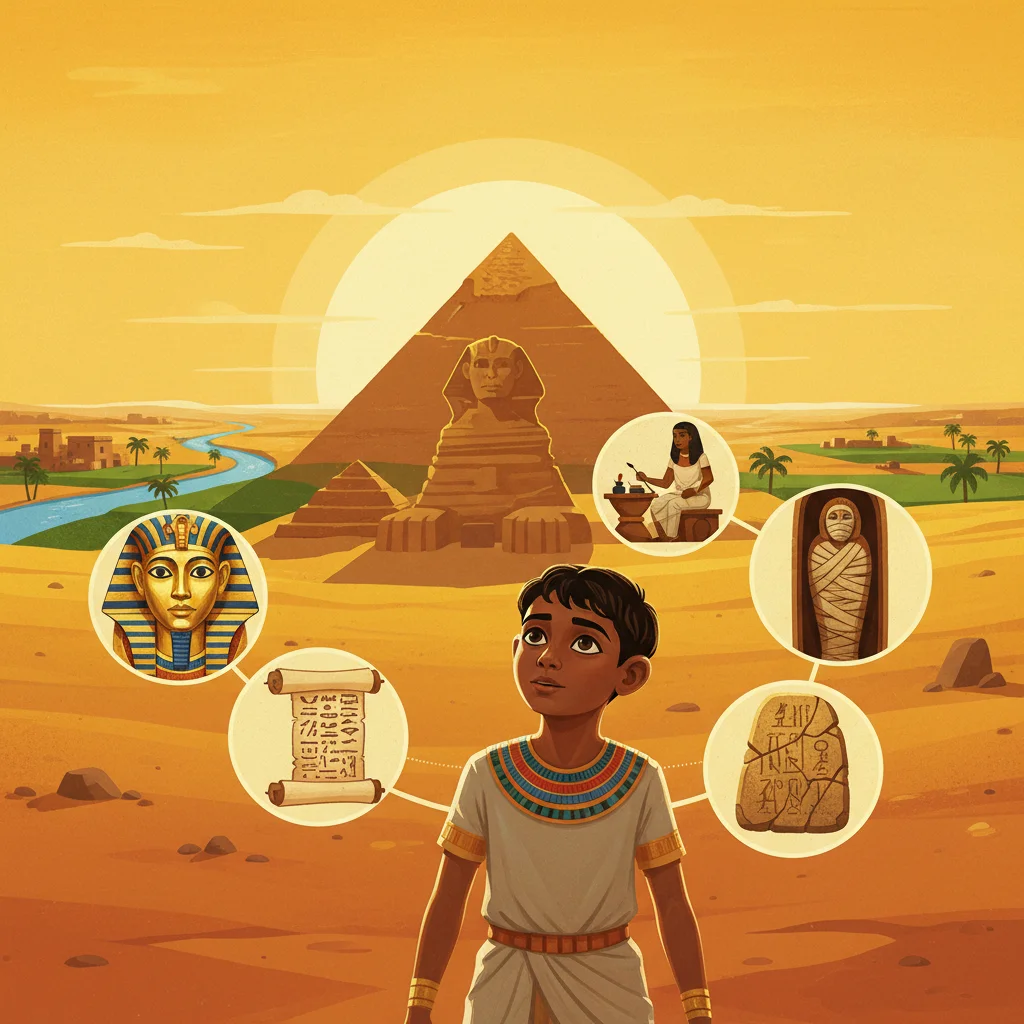
Secrets of Ancient Egypt
Narrated in Swedish, English, Norwegian
Read-along text in English, Swedish, Norwegian, Danish, Finnish, German and Spanish.
Narrated in Swedish, English, Norwegian
Read-along text in English, Swedish, Norwegian, Danish, Finnish, German and Spanish.
More than five thousand years ago, along the banks of a life-giving river in Africa, people built one of the most extraordinary civilisations in history. They created art and architecture that still stands today. They invented their own writing system. They asked questions about the universe and the human body and built monuments that astonished the world. We call them ancient Egypt, and their story begins at the banks of the Nile.
Egypt is in north-east Africa, and it is a land shaped by contrasts. On one side, desert, vast, dry, sandy desert stretching mile after mile without a single tree. On the other side, water, the great and mighty Nile, one of the world's longest rivers. It was right along the Nile that Egyptian life flourished. Without the river, there would have been no Egypt at all. The Nile was not just a river. It was the heart of the entire civilisation.
The Nile is more than 6,600 kilometres long, that is almost like travelling from Sweden to Egypt and back. It flows northward, from the heart of Africa all the way to the Mediterranean Sea. Along its banks grew papyrus plants, a kind of tall, thick grass that the Egyptians used to make boats, baskets, and even an early kind of paper. They called it papyrus, and that is actually where our word paper comes from! The Nile was also a highway, a way to transport goods, people, and materials up and down the country.
Every year, something wonderful happened with the Nile, it flooded. For a few months the water rose and spread out over the fields along the banks. That might sound frightening, but the Egyptians loved it! The flood carried dark, rich mud, which they called kemet, and laid a layer of it on the fields. This fertile mud was perfect for growing grain, onions, cucumbers, and lentils. Without the returning flood, the land would have been nothing but dry sand and stone. It was the Nile's gift that fed the whole civilisation.
When you think of Egypt, you probably think of pyramids. That is hardly surprising, they are one of humanity's most astonishing constructions, and they have stood for thousands of years. But what is a pyramid, exactly? It is an enormous grave, built for one of Egypt's most powerful leaders, a pharaoh. Inside the pyramid lay the pharaoh's mummified body, surrounded by treasures and objects for life after death. The Egyptians believed strongly that life did not end when you died, and the pyramids were proof of that belief.
Continue the story in Fabeligo, read aloud and illustrated
Listen in the app