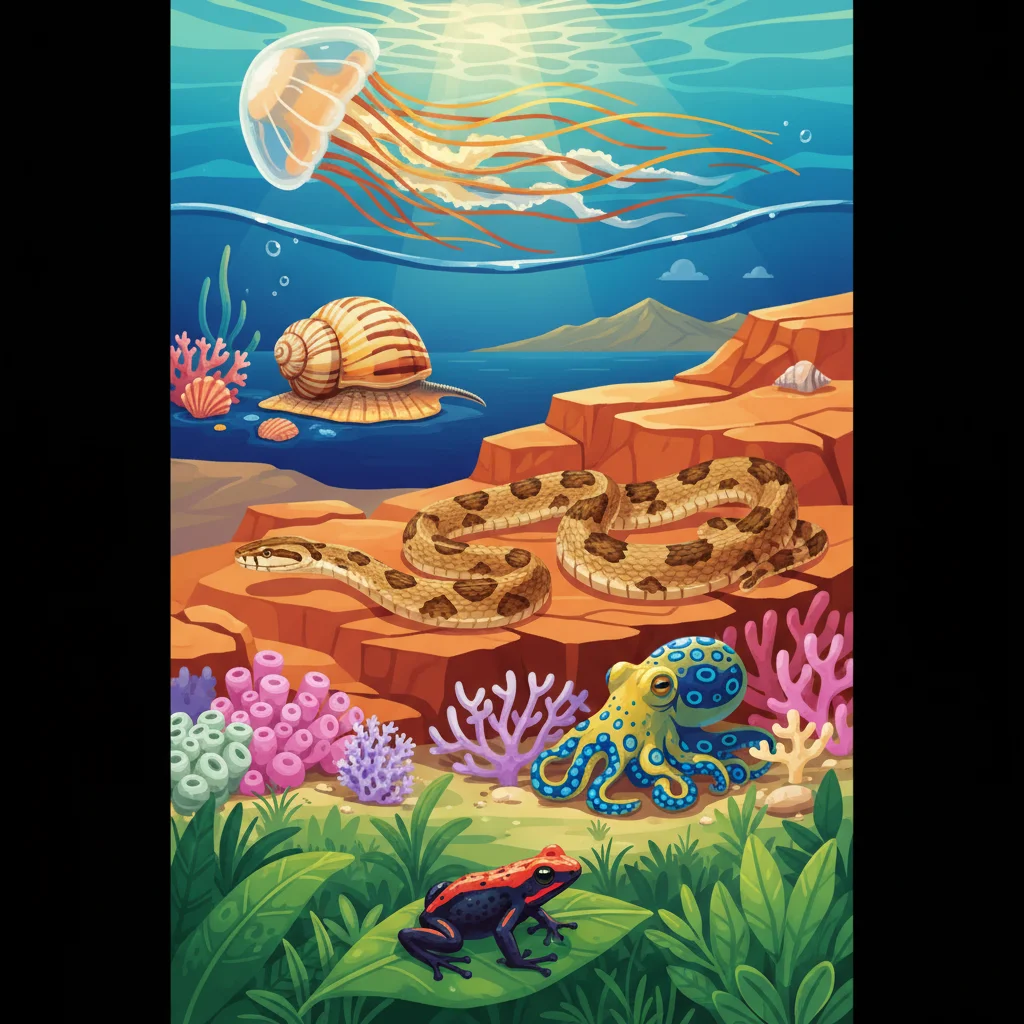
The World's Most Venomous Animals
Narrated in Swedish, English, Norwegian
Read-along text in English, Swedish, Norwegian, Danish, Finnish, German and Spanish.
Narrated in Swedish, English, Norwegian
Read-along text in English, Swedish, Norwegian, Danish, Finnish, German and Spanish.
Imagine walking along a tropical beach. The water is warm and clear, and nothing seems dangerous at all. But right beneath the surface, one of nature's most remarkable animals drifts past, invisible as glass, with tentacles stretching a full metre. Nature is full of secret weapons, and today we are going to meet five animals that have developed the most powerful ones of all. This is not about monsters, it is about evolution, about clever solutions for hunting and protecting yourself. Welcome to the world's most venomous animals!
Before we meet these amazing animals, we need to learn one word, toxin. But there are actually two kinds of toxin, and they work in completely different ways. If an animal has a bite, a sting, or a stinger that injects toxin into another animal, it is venomous, it delivers the toxin actively. If an animal is dangerous to touch or eat because the toxin sits in its skin or body, it is poisonous. Snakes and spiders are venomous, they inject venom when they bite. A poisonous mushroom is dangerous because you eat it. That difference matters, and we will remember it when we meet the frogs a little later!
Venom, meaning toxin that is actively delivered, is something that hundreds of animals have developed completely independently of each other. Snakes, spiders, scorpions, jellyfish, fish, even a platypus! It is one of evolution's most widespread experiments. Why did so many animals invent venom? The answer is actually simple: it works. Venom helps animals catch prey that is faster than them, and venom helps animals defend themselves against enemies that are larger than them. It is like having an enormous power hidden in a tiny little package. And every animal has found its own completely unique version of that package.
Now it is time to meet the first animal, the box jellyfish. It lives in warm tropical seas, especially around Australia and Southeast Asia. And the strangest thing about the box jellyfish is that it is almost invisible. It is transparent as glass, a bit like a small cube-shaped balloon drifting along with the current. The body can be roughly the size of a football, and the tentacles, the thin threads hanging beneath it, can grow more than a metre long. Unlike most jellyfish, the box jellyfish actually swims actively, with real eyes that see where it is going.
Continue the story in Fabeligo, read aloud and illustrated
Listen in the app