The Power of Volcanoes
Narrated in Swedish, English, Norwegian
Read-along text in English, Swedish, Norwegian, Danish, Finnish, German and Spanish.
Narrated in Swedish, English, Norwegian
Read-along text in English, Swedish, Norwegian, Danish, Finnish, German and Spanish.
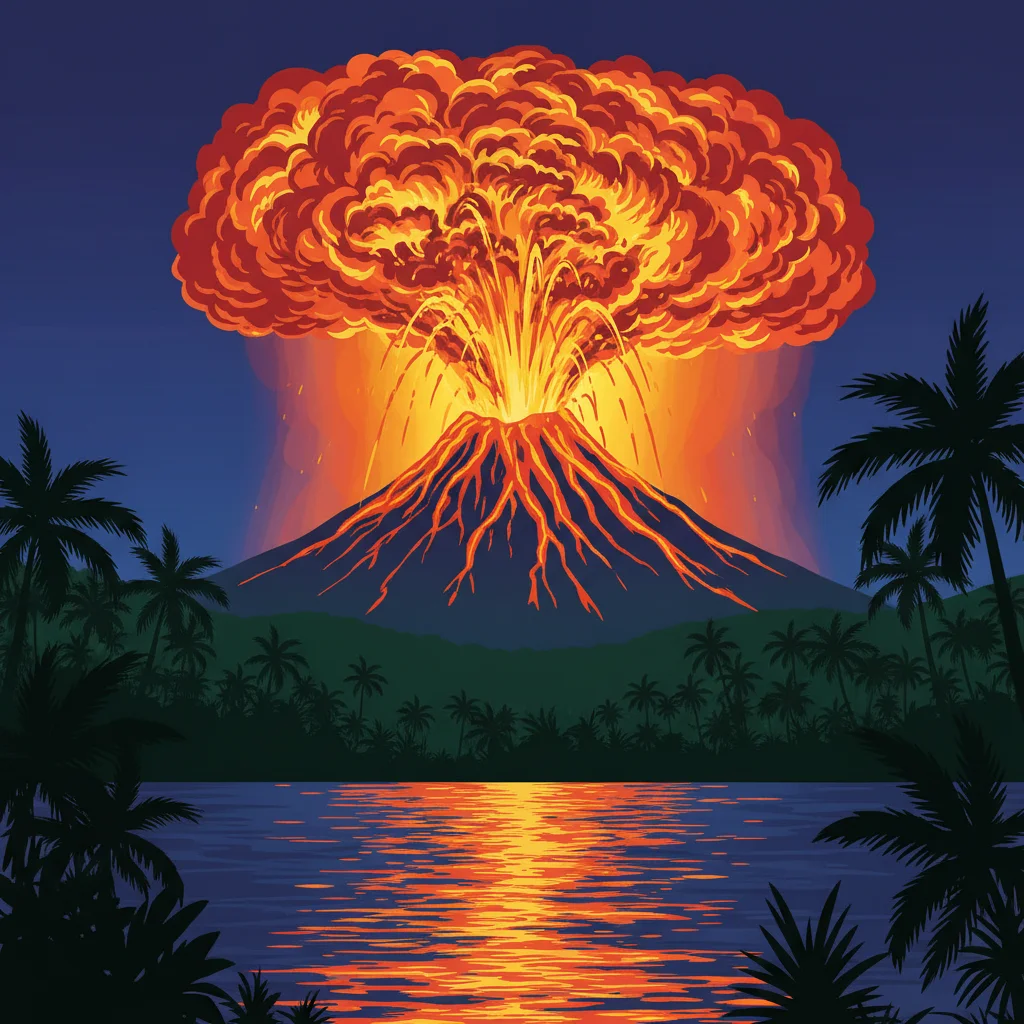
Imagine standing on a mountain that breathes. The ground beneath your feet is warm. High above, a cloud of white steam rises into the sky. This is no ordinary mountain, it is a volcano. And volcanoes are some of the most powerful and beautiful forces on our entire planet.
But how does a volcano actually work? To understand that, we need to travel deep into the Earth's interior. Our planet is like a giant hard-boiled egg, it has a shell on the outside and soft layers inside. The outermost layer, where we live, is called the crust.
Beneath the crust lies a thick layer called the mantle. The mantle is not liquid like water, it is more like very hot, sticky clay. It is so hot that rocks down there can actually melt! It might take thousands of years for the mantle to move slowly, but it is always moving.
And right at the very centre of our planet, nearly five thousand kilometres beneath your feet, is the Earth's core. The core is incredibly hot, roughly as hot as the surface of the sun! The inner core is solid and made of iron and nickel. Around it sits an outer core of liquid metal.
Now we know about the crust, the mantle, and the core. But how does all this connect to volcanoes? The crust is not one single solid shell. It is broken into large pieces, like a cracked eggshell. These pieces are called tectonic plates. And they move, very, very slowly.
Tectonic plates move roughly as fast as your fingernails grow, just a few centimetres a year. That sounds small, but over millions of years they have moved enormous distances! And when plates collide or pull apart, exciting things happen.
When plates collide, one can get pushed beneath the other, down into the hot mantle. There it melts and forms liquid rock. That liquid rock is called magma, that is hot molten rock deep inside the Earth. The magma rises upwards, because it is lighter and more bubbly than the hard rock around it.
The magma collects in a large underground space called the magma chamber. Imagine a giant underground cavern filled with glowing, bubbling molten rock. The pressure in the chamber grows and grows, like blowing up a balloon. Eventually, pop! The magma needs to find a way out.
Continue the story in Fabeligo, read aloud and illustrated
Listen in the app