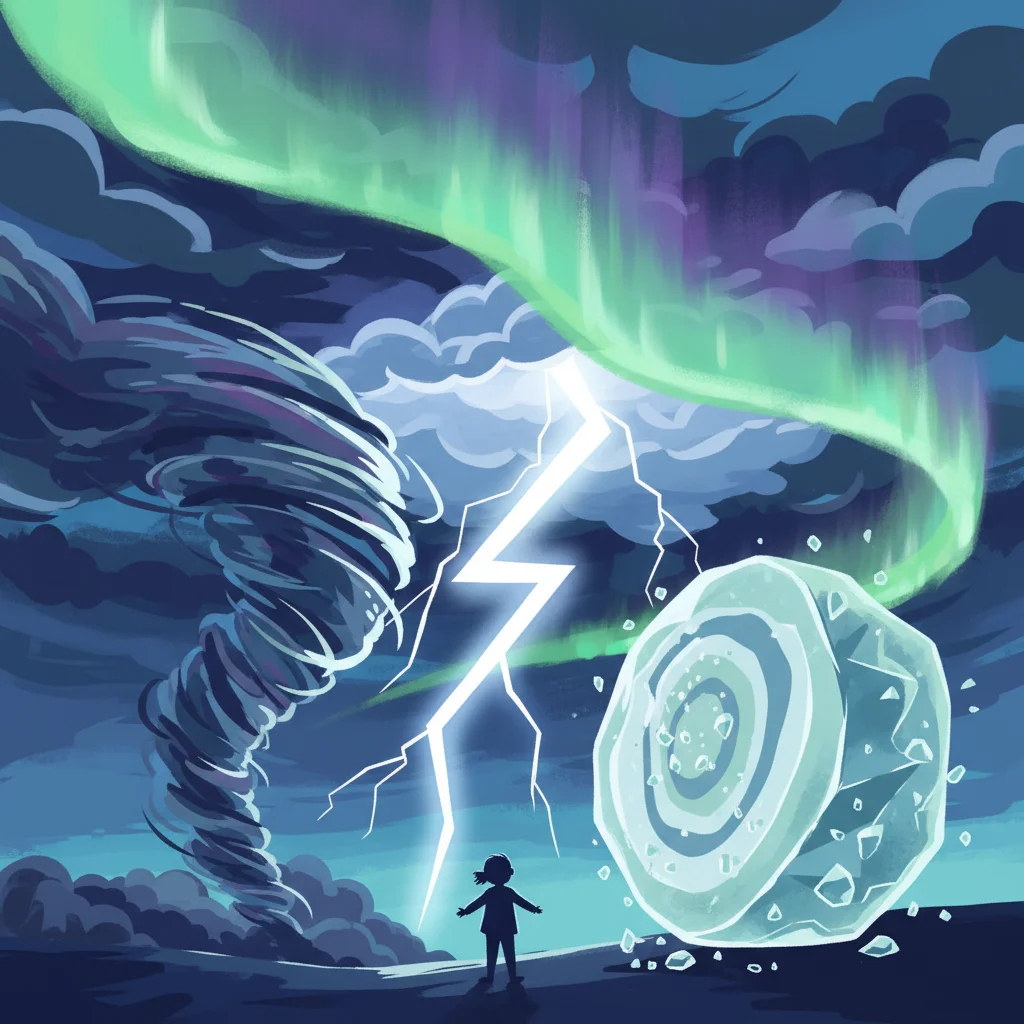
Extreme Weather Wonders
Narrated in Swedish, English, Norwegian
Read-along text in English, Swedish, Norwegian, Danish, Finnish, German and Spanish.
Narrated in Swedish, English, Norwegian
Read-along text in English, Swedish, Norwegian, Danish, Finnish, German and Spanish.
Imagine looking out through a window and seeing dark clouds rolling across the sky. The wind picks up. The air smells different. Something is about to happen! Weather is not just sunshine and rain, it is the Earth's own way of moving air and water around. Our planet is like a big machine, and the atmosphere, the layer of air around us, is the engine. Let us find out how it works.
All weather starts with the Sun. The Sun warms the Earth's surface, and warm air rises upward. Cooler air flows in to fill the space. That creates wind! Air moves all the time, from warm areas near the equator up towards the cold poles and back again. It is like a giant circuit of air that never stops. And in that circuit all of Earth's different weather is born.
But how do clouds form? It is all about water. The Sun warms the sea and lakes, and the water turns into water vapour, invisible gas that floats upward. High up in the air it is cold. There the vapour cools down and turns into billions of tiny droplets. Each droplet is so small it can float in the air. Together the droplets make what we see as a cloud! We are actually looking at water when we look at clouds.
There are many different kinds of clouds. High up in the sky, so high it is really cold, we find thin, feather-light clouds called cirrus clouds. They are made of ice crystals and look like white brushstrokes across the sky. Lower down form the thick, fluffy clouds we call cumulus clouds, the big, white, bubbly clouds that look like giant cotton wool. And then there are enormous storm clouds, cumulonimbus, that can be ten kilometres tall! It is inside those clouds that lightning and thunder are born.
Inside a big storm cloud something amazing happens. Powerful air currents carry water droplets and ice crystals up and down, over and over again. In that movement the droplets and crystals rub against each other. That creates static electricity, just like when you rub a balloon against your hair and it stands up! The charges build up. Positive charge gathers at the top of the cloud, negative charge at the bottom. And finally, when the difference is big enough, it happens. A lightning bolt!
Continue the story in Fabeligo, read aloud and illustrated
Listen in the app