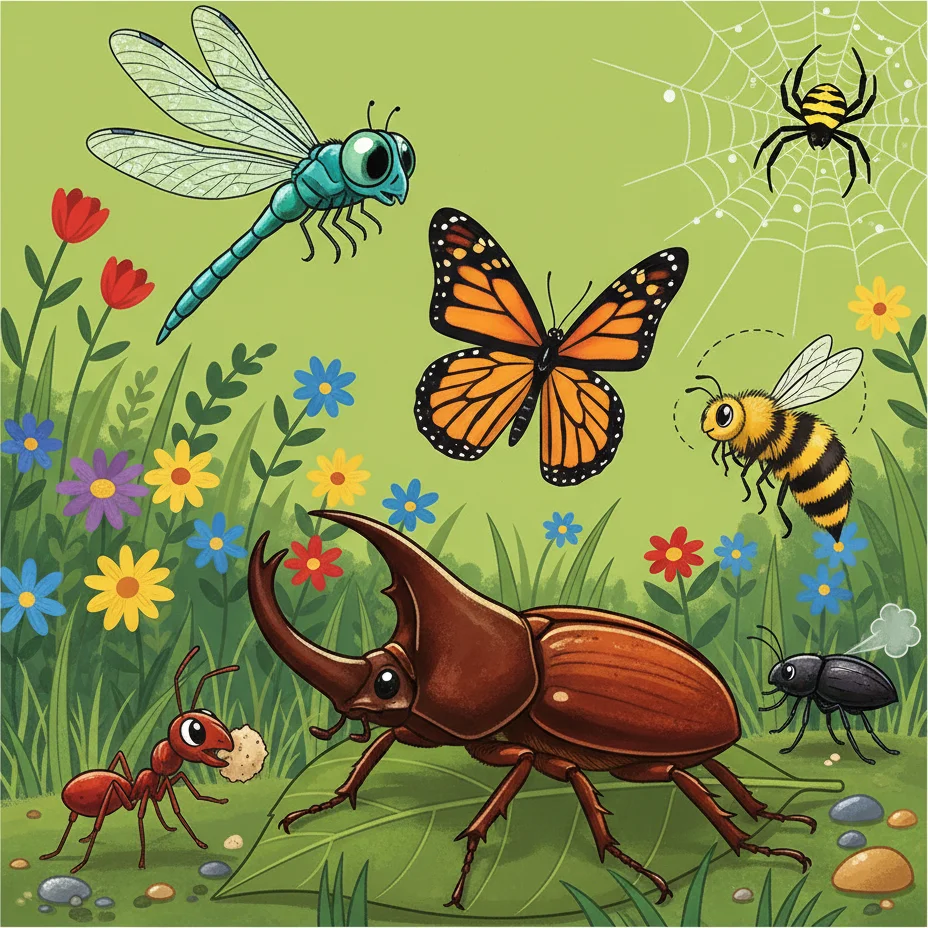
Tiny Giants: The World of Bugs
Narrated in Swedish, English, Norwegian
Read-along text in English, Swedish, Norwegian, Danish, Finnish, German and Spanish.
Narrated in Swedish, English, Norwegian
Read-along text in English, Swedish, Norwegian, Danish, Finnish, German and Spanish.
Look down at the ground next time you are outside. It might seem empty, but it is actually packed with life. Under your feet, among the grass blades and leaves, millions of tiny creatures are moving around. Insects and spiders and worms are building homes, hunting food, and talking to each other, just like us! They are small, but small does not mean simple. Welcome to the world of the tiny giants.
There are more insects on Earth than any other animal. Scientists think there are about ten quintillion insects, that is a ten followed by eighteen zeros! We have found over one million different species, and new ones keep turning up. Insects live on every continent except Antarctica. Insects have been on Earth for more than 400 million years, long before the dinosaurs even appeared. They are not newcomers to our world. We are the ones living in theirs.
An ant colony is one of nature's most impressive constructions. Inside a single ant nest, hundreds of thousands of ants can live, sometimes even more. But all those ants know exactly what they need to do. There is a queen, who lays the eggs. There are worker ants, who collect food and look after the young. And there are soldiers, who guard the entrances. Everyone works for the colony. No one tells them what to do, they just know.
But how do ants know what to do? The secret is smell. Ants communicate using chemical signals called pheromones, pheromone means a special smell-message that bugs use to talk to each other. When an ant finds food, it leaves a pheromone trail on the way home. Other ants can smell it and follow the path. If an enemy appears, soldiers release an alarm pheromone that spreads quickly and the whole colony is on alert. It is an entire language, written in scent and air.
If you look carefully, you can spot ant trails on the ground, thin paths that hundreds of ants march along. Those are the pheromone trails doing their job! Each ant that passes leaves a little more scent, and the trail gets stronger. When the food runs out, the ants stop leaving scent, and the trail fades. So the colony automatically knows when it is time to find a new source. No meetings. No bosses. Just chemistry.
Continue the story in Fabeligo, read aloud and illustrated
Listen in the app