A Tour of Our Solar System
Narrated in Swedish, English, Norwegian
Read-along text in English, Swedish, Norwegian, Danish, Finnish, German and Spanish.
Narrated in Swedish, English, Norwegian
Read-along text in English, Swedish, Norwegian, Danish, Finnish, German and Spanish.
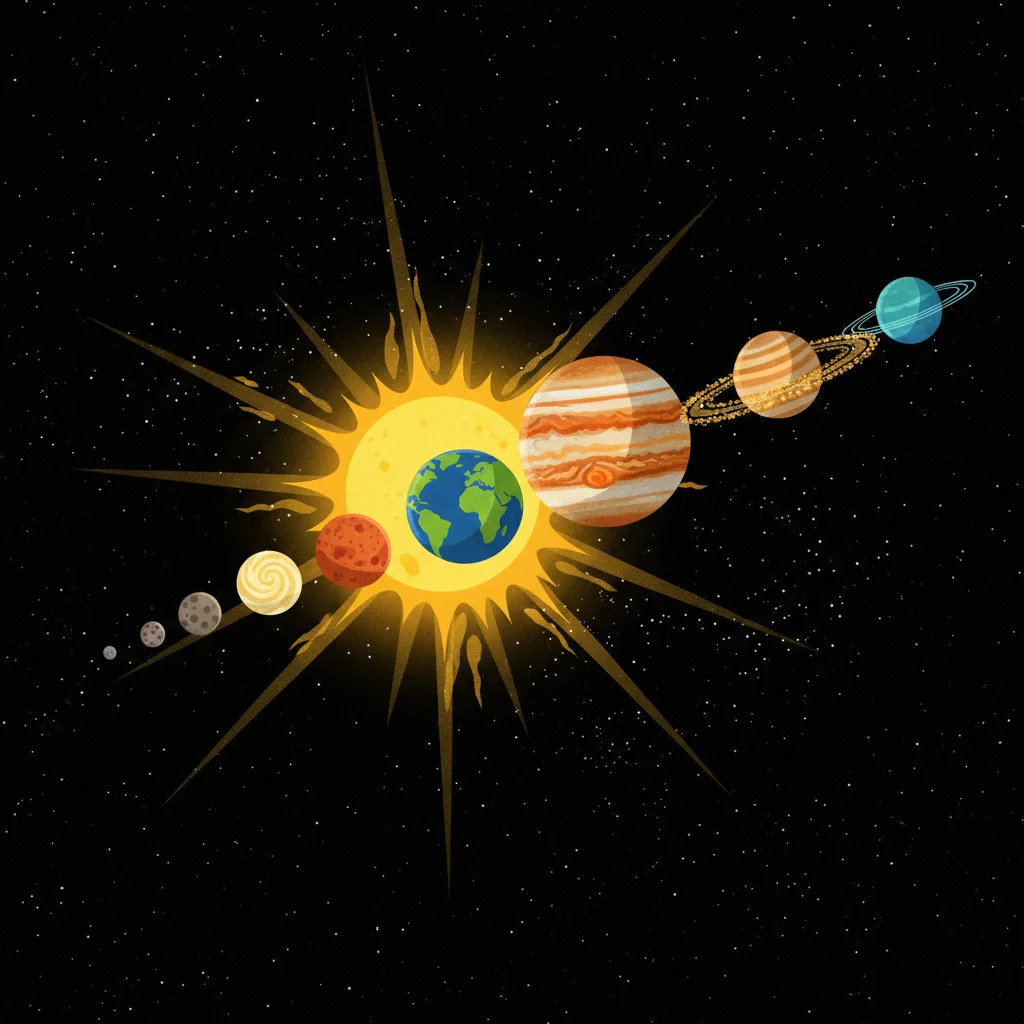
Look up at the sky on a clear night. All those glowing dots, they are not all stars. Some of them are actually planets, just like our own Earth! We live in a solar system, a family of planets all circling around one big shining star. Our star is called the Sun. And that is where our journey begins.
We begin with the Sun itself. The Sun is not a planet, it is a star! A star is an enormous ball of glowing hot gas. The Sun is so big that about one million Earths could fit inside it. It is powered by a process called nuclear fusion, deep inside the Sun, hydrogen atoms are squeezed together and release an incredible amount of light and heat. That is the warmth that keeps us warm here on Earth.
Now we fly towards the first planet, Mercury. It is the planet closest to the Sun, and it is small, grey, and rocky. Because Mercury is so close to the Sun, it races around the Sun very fast. One year on Mercury, that is one trip around the Sun, takes just 88 days. But one day on Mercury, meaning the time from one sunrise to the next, takes almost 176 Earth days. So a year there is actually shorter than a day!
Mercury has no atmosphere, no air at all around it. That means there is no wind to spread heat, and nothing to protect the planet from the Sun's rays or the cold of night. On the side facing the Sun, it can reach almost 430 degrees. But at night, the temperature drops to minus 180 degrees. That is the largest temperature swing we know of among all the planets in the solar system.
The next planet is Venus, and it is full of surprises. Venus is similar in size to Earth, but it is actually the hottest planet in the entire solar system, even though it is not even the closest to the Sun. The secret? A thick atmosphere of carbon dioxide wraps around the planet like a blanket and traps the heat inside, just like a greenhouse. The temperature on Venus is about 465 degrees, hot enough to melt lead.
Continue the story in Fabeligo, read aloud and illustrated
Listen in the app